Define targets in a common frame
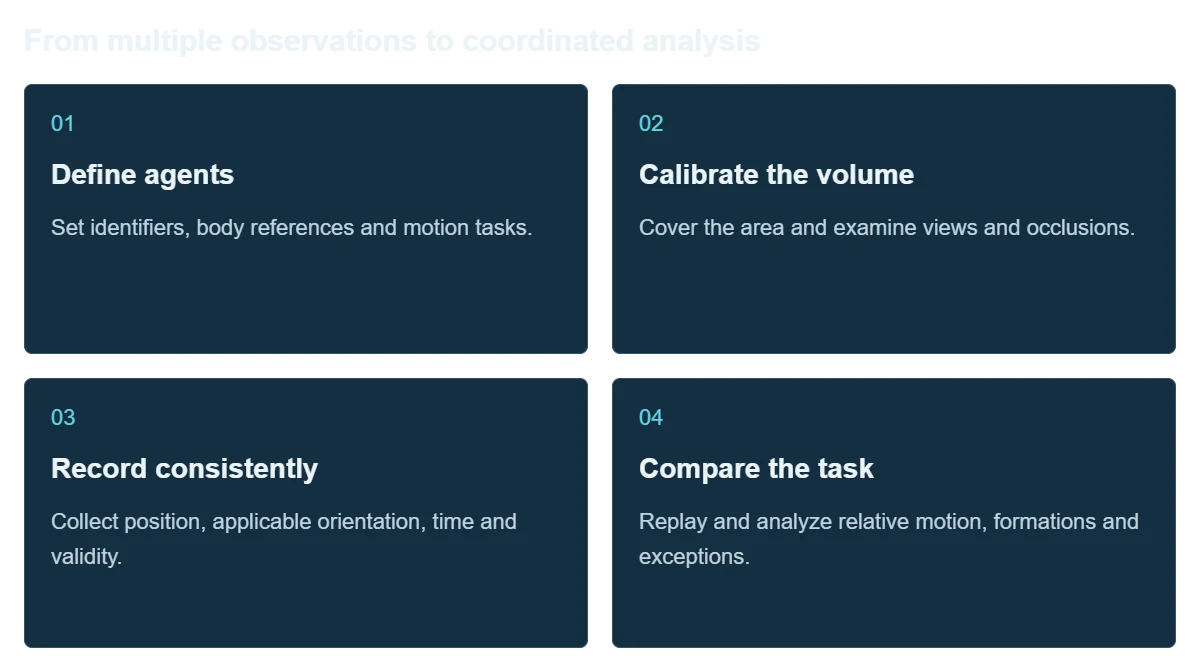
Assign stable identifiers and references to each agent. Specify the relationship between measured position, orientation and the body frame so observations can be compared in one calibrated space.

Robotics Motion Measurement
Compare multiple moving targets in one reference frame.
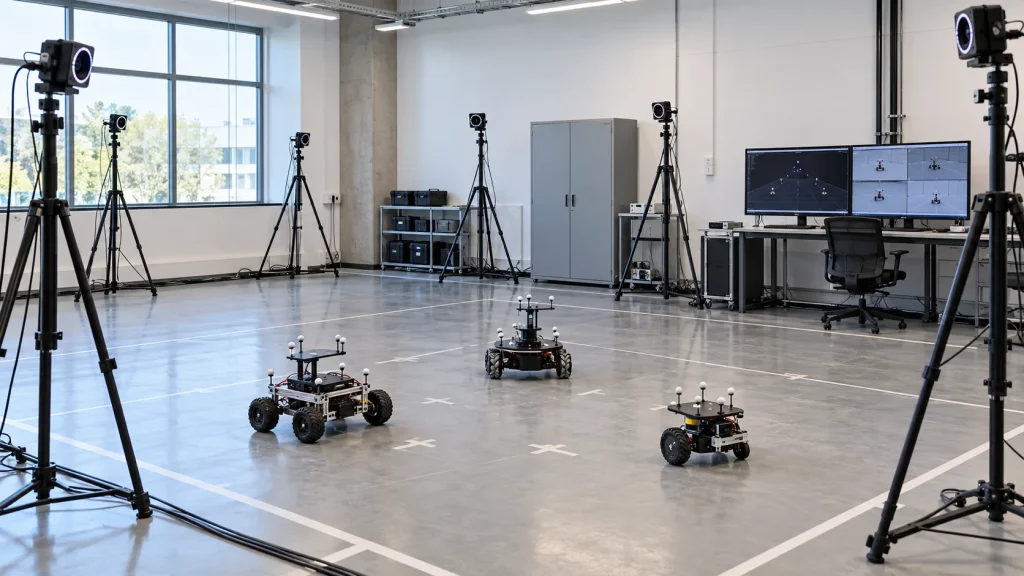
Lecen’s multi-agent positioning solution plans localization, trajectory recording and relative-motion analysis for mobile robots and multi-target experiments. Target identities, spatial calibration and time alignment organize observations for formation, crossing-path and coordination studies.
Product brand: Lecen Technology
Project goals
With several targets, visibility is only part of the problem. Identity stability, crossing paths and the timing of observations also matter. The design begins with defined targets, an observable volume and data validity; an advertised target count is not a substitute for a concurrent experiment in your space.
In focus
Assign stable identifiers and references to each agent. Specify the relationship between measured position, orientation and the body frame so observations can be compared in one calibrated space.
Evaluate close encounters, formation changes and similar-looking targets. Camera views, target geometry and actual motion must be planned together to reduce association ambiguity.
Retain timestamps and distinguish valid, missing and estimated samples. Align observations before computing distances or formations so samples from different moments are not treated as simultaneous.
Compare relative distances, crossing paths, formation changes and repeated trials with preserved raw tracks and processing methods. Plan export or research-tool integration around the required data interface.
Workflow
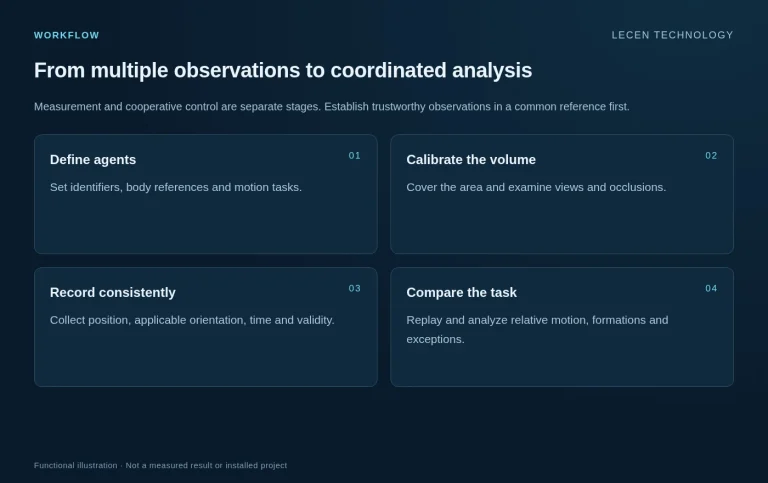
Measurement and cooperative control are separate stages. Establish trustworthy observations in a common reference first.
Set identifiers, body references and motion tasks.
Cover the area and examine views and occlusions.
Collect position, applicable orientation, time and validity.
Replay and analyze relative motion, formations and exceptions.
Integration
Validate each target definition before increasing the number and complexity of movements. Document conditions that were actually tested.
Specify count, size, speed, operating area and required outputs.
Plan observation views, target components and common coordinates.
Evaluate timestamps, latency, updates and missing-data flags.
Exercise encounters, formation changes, entry/exit and recovery, preserving trial records.
Configuration
| Objects | Mobile robots or other defined targets within the experimental volume |
|---|---|
| Reference | Common coordinates, units, origin and body frames |
| Target data | Identity, position, applicable orientation, time and validity |
| Concurrency | Validated around size, speed, occlusion and spatial layout |
| Analysis | Relative motion, paths, formations and repeated trials |
| Integration | Data exchange matched to research tools and controller logs |
Applications
Observe relative positions and crossing paths to compare algorithms.
Study formations and identity stability in a controlled volume with independent safety measures.
Compare collective paths, timing and exceptional intervals across strategies.
FAQ
No. Size, identification method, speed, occlusion and layout affect operation. Use representative concurrent trials.
Check timing definitions throughout capture, transport and reception. Equal update rates do not guarantee simultaneous observations.
Preserve missing or estimated status and assess identity and trajectory recovery. Do not present interpolated samples as direct observations without distinction.
The scope is positioning, measurement and experimental analysis. Navigation, cooperative control and safety avoidance belong to their respective control systems and need separate integration validation.
No. Changes in illumination, weather, range, visibility and target placement require renewed evaluation.
Project brief
Count, dimensions, target mounting and motion speed.
Layout, boundaries, occlusions, lighting and independent safety arrangements.
Frames, timing, interfaces, trial organization and comparison metrics.
Explore more
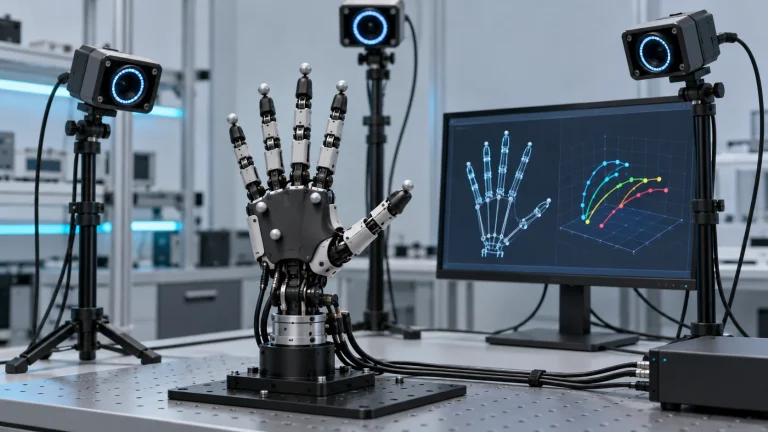
Robotics Motion Measurement
Capture hand motion as reviewable experimental data.
AI-generated concept, not a product or project photograph.
Explore solution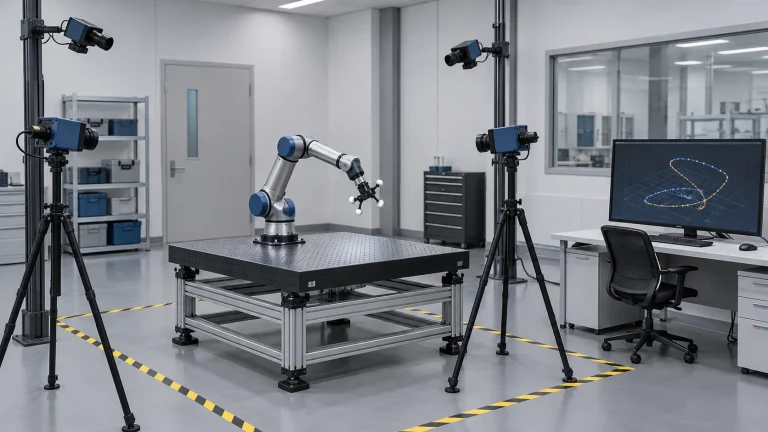
Robotics Motion Measurement
Compare observed movement with the commanded path.
AI-generated concept, not a product or project photograph.
Explore solutionTalk to Lecen
Define targets, working volume, movement speeds and required outputs to discuss observation methods and validation.